Artificial intelligence is increasingly discussed within the UK estate agency sector, but reliable, property-specific data is limited. This page brings together public statistics, industry surveys, and anonymised platform data to provide a clear, factual snapshot of how AI is currently being used by estate agents in the UK.
This page is updated periodically and is intended as a reference source for journalists, researchers, and industry professionals.
Key Statistics at a Glance
- AI adoption among UK estate agencies remains early-stage but growing
- Most AI usage is currently focused on marketing and communication, rather than sales outcomes
- Awareness of AI tools is significantly higher than actual day-to-day usage
- Voice and audio-based AI tools are emerging primarily in property listings and enquiry handling
- Out-of-hours interaction is one of the clearest observed AI usage patterns
All figures on this page are derived from publicly available datasets, industry surveys, or anonymised and aggregated Voceva usage data.
How This Data Was Compiled
This report combines multiple sources to avoid relying on a single dataset.
Sources include
- UK public sector statistics
- Industry and trade body publications
- Surveys of UK estate agents
- Aggregated and anonymised interaction data from the Voceva platform
Methodology notes
- All Voceva data is anonymised and aggregated
- No personal data, property addresses, or individual agency metrics are included
- UK-only data is used throughout
- Figures reflect adoption and usage patterns, not performance outcomes
Where estimates are used, they are clearly labelled as such.
How Many Estate Agencies Are There in the UK
The UK estate agency sector is made up predominantly of small and medium-sized businesses, alongside a smaller number of regional and national chains.
According to data published by the Office for National Statistics, there are tens of thousands of businesses operating within estate agency, property letting, and related real estate services across the UK.
For the purposes of this report:
- Both sales and lettings agencies are included
- Independent agencies and chains are counted
- Online-only agencies are included where they operate in the UK market
Exact figures vary depending on classification, but this provides a reasonable baseline for understanding AI adoption at a national level.
AI Adoption in UK Estate Agencies
Estimated Adoption Levels
Based on a combination of industry surveys and platform-level signals, AI adoption among UK estate agencies can be described as:
- Low but increasing
- Concentrated among early adopters and tech-forward agencies
- More common in marketing and communication than operational decision-making
Current estimates suggest that a minority of UK estate agencies actively use AI tools, while a much larger proportion are aware of them.
Awareness vs Actual Usage
A consistent pattern across surveys is the gap between:
- Awareness of AI tools
- Regular operational usage
Many agencies report familiarity with AI concepts such as content generation or automated responses, but fewer have integrated AI into daily workflows.
This gap is common across UK SMEs and not unique to estate agencies.
What Estate Agents Use AI For
AI usage within estate agencies currently falls into several broad categories
Marketing and Content
- Property descriptions
- Website content
- Listing enhancements
Communication
- Automated responses to enquiries
- Audio or voice-based property information
- Out-of-hours interaction handling
Administration
- Drafting internal documents
- Data summarisation
- Workflow assistance
Most usage is assistive, supporting existing processes rather than replacing them.
AI in Property Marketing vs Operations
AI adoption is currently stronger in marketing than operations.
- Marketing AI is easier to test and deploy
- Operational AI carries higher perceived risk
- Agencies remain cautious about customer-facing automation
As a result, AI is more likely to be used to enhance listings and communication rather than manage negotiations or pricing decisions.
Early Usage Signals From Live Property Listings
Anonymised Voceva usage data provides early insight into how AI-driven audio features are interacted with on live property listings.
Observed patterns include:
- Interaction peaks outside standard office hours
- Short, repeated engagement sessions
- Higher usage on listings where audio is clearly presented as an option
These signals describe interaction behaviour only. They do not indicate sales performance, enquiry quality, or transaction outcomes.
Barriers to AI Adoption in Estate Agencies
Several recurring concerns appear across industry commentary and surveys.
Trust and Accuracy
Agents remain cautious about AI-generated information being perceived as inaccurate or misleading.
Reputation Risk
Estate agencies place high value on local reputation, making them wary of automation errors.
Cost and Complexity
Uncertainty around pricing, setup time, and return on investment slows adoption.
Compliance and Transparency
Agencies want clarity around disclosure, data protection, and regulatory expectations.
How Estate Agency AI Adoption Compares to Other UK SMEs
Across UK small and medium-sized businesses:
- AI adoption is increasing gradually
- Usage is typically narrow and task-specific
- Full automation remains rare
Estate agencies broadly mirror this pattern, with no evidence that property businesses are significantly ahead or behind other SME sectors.
What the Data Does Not Show
To maintain accuracy and avoid over-claiming, it is important to state what current data cannot demonstrate.
This report does not show:
- That AI increases property sales
- That AI improves enquiry quality
- That AI shortens time to completion
- That AI replaces human staff
Future datasets may explore these questions, but current evidence does not support definitive conclusions.
AI Voice Adoption And Engagement Trends (Yearly Comparison)
| Year | Global Voice Adoption | UK Voice Adoption | Preference For Voice | Satisfaction With Voice | Business Adoption Signal | Relevance To Property Listings |
|---|---|---|---|---|---|---|
| 2022 | Approx. 4.2 billion voice assistants in use worldwide | Over half of UK adults had access to a voice assistant | Around 65 percent prefer voice over typing when available | Approx. 89 percent positive user sentiment | Rapid growth in smart speakers and mobile voice use | Early indication that buyers are comfortable consuming spoken information |
| 2023 | Approx. 6.4 billion voice assistants globally | Continued UK growth driven by mobile and home devices | Around 68 percent prefer voice for quick information | Approx. 91 percent satisfaction | Businesses begin embedding voice into websites | Voice becomes practical for content heavy listings |
| 2024 | Around 8 billion voice assistants in active use | Ofcom reports strong familiarity across UK demographics | Around 71 percent prefer voice to typing | Approx. 93 percent satisfaction | Voice used beyond search, into content delivery | Strong alignment with property browsing behaviour |
| 2025 (projected) | 8.4 billion plus voice assistants worldwide | Voice considered normal digital interaction in the UK | Preference expected to exceed 70 percent | Satisfaction expected to remain high | Voice seen as standard UX not novelty | Early adopters stand out as more modern and accessible |
| 2026 projected | Continued growth beyond 9 billion global devices based on market forecasts | Voice embedded into mainstream UK digital services | Preference stabilises at high levels | High trust maintained in natural AI voices | Voice increasingly integrated into websites and apps | Voice on property listings moves from differentiator to expectation |
Methodology Note
The statistics shown above are based on aggregated global and UK research from voice technology, digital behaviour, and consumer experience studies published between 2022 and 2024. Where direct estate agent specific data is not available, broader voice adoption and engagement trends are used to indicate buyer behaviour patterns that also apply to property listings. Figures are rounded for clarity and updated annually as new data becomes available.
What The Trend Line Is Showing
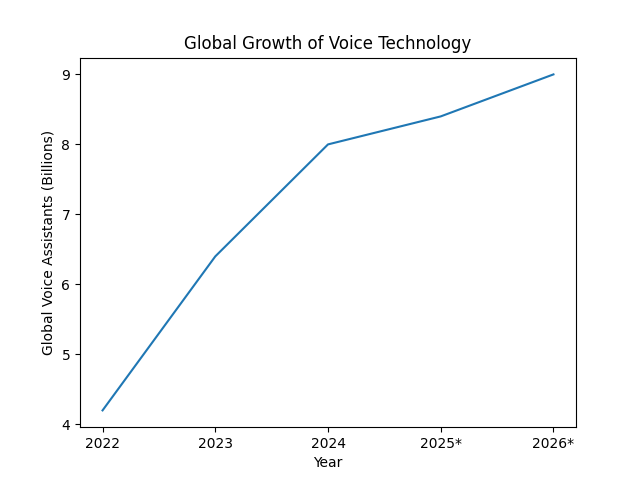
If you step back and look at the direction rather than individual numbers, a very clear pattern appears.
Every year, voice adoption increases globally.
Every year, user preference for voice rises or stabilises at high levels.
Every year, satisfaction with voice technology remains extremely strong.
This is not a short term spike. It is behavioural normalisation.
For estate agents, that means something important.
Buyers are becoming more comfortable listening to information online. They trust it. They expect it. And they engage with it when it is available.
AI voice on property listings is not trying to create a new behaviour. It is aligning with an existing one.
In simple terms, voice is moving from innovation to expectation.
Related AI & Estate Agency Data Reports
- How many UK estate agents use AI
- AI in property marketing statistics
- Buyer interaction with audio property listings
- Out-of-hours engagement data in estate agency
These reports expand on specific areas referenced on this page.
Citation & Reuse Policy
Journalists, researchers, and publishers are welcome to reference data from this page.
Citation guidance
- Attribute statistics to “Voceva AI Estate Agency Statistics”
- Link to this page where possible
- Quote figures accurately and in context
For press enquiries or clarification, contact details should be provided here.
Last Updated
Last updated: January 2026
Next scheduled update: Quarterly