VOCEVA.AI)))
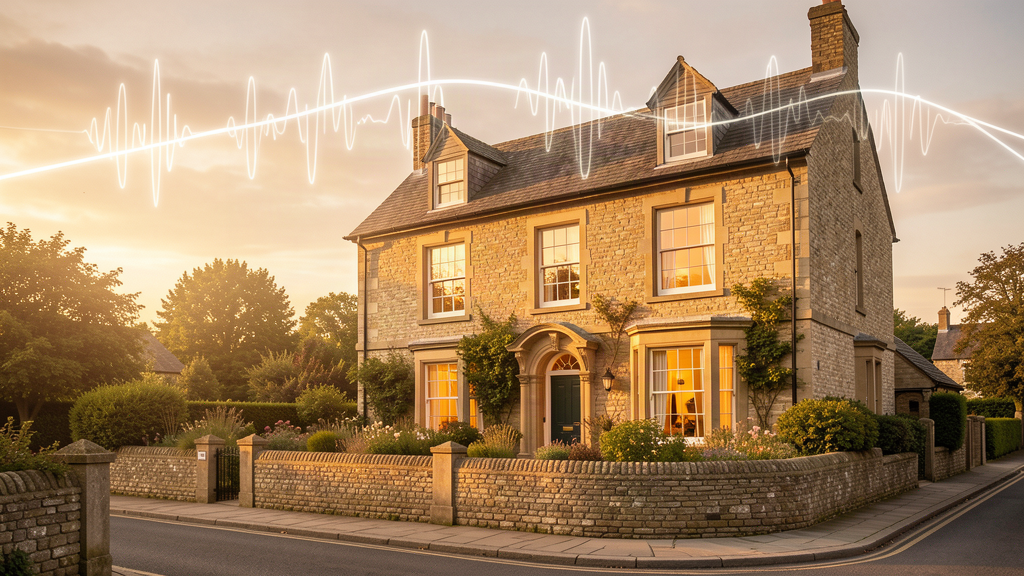
Why Luxury Property Listings Deserve a Narrative, Not Just a Description
4 minute read, 3 if you're quick
There is a particular kind of frustration that comes with reading a luxury property listing. You have a four-bedroom Regency townhouse in Cheltenham with original cornicing, a walled garden that gets afternoon sun until eight in the evening, and the kind of quiet side street where residents still say good morning to each other. The listing says: beautifully presented four-bedroom property with garden, close to amenities.
That is not a description. That is a placeholder. And if you are running a boutique agency that has built its reputation on knowing what makes your patch special, it is also a bit embarrassing.
The problem is not laziness. It is format. Text descriptions are written to be scanned, not read. They sit alongside photographs, floor plans, and energy ratings. Nobody reads them the way you would read a piece of writing — they parse them for square footage and bedroom count. The actual character of a property, the thing that makes a buyer feel something, does not survive that format. It gets compressed out.
Voice does not have that problem.
When someone hears a description — a real spoken narration, not text-to-speech reading out bullet points — they process it differently. It is not about the words being better. It is that the medium itself is different. Listening is an absorptive experience. Reading is extractive. A buyer who hears a 45-second voice description of a property while they are already looking at the photographs is receiving that information in a way that builds feeling rather than just logging facts.
For a high-value listing, that distinction matters enormously. Premium property decisions are not made on spreadsheets. They are made on a Saturday morning when someone visits a house, stands in the kitchen, and thinks: yes, this is it. Everything that happens before that visit — the portal browsing, the website research, the shortlisting — is about getting to a feeling that is strong enough to book a viewing. Text rarely gets you there. A well-crafted voice narration can.
Now, the obvious objection: agents have tried recorded audio before. It normally involves a junior member of staff reading an awkward script into a phone in a quiet corner of the office, and the results are predictably patchy. One person sounds enthusiastic, another sounds like they would rather be anywhere else. The brand inconsistency alone is a problem, never mind the quality. And the cost and effort of doing it properly — professional recording, proper scripting, editing — is prohibitive at scale.
What Voceva does is different in a specific way. The narration is generated from the listing data and area information that is already in your system. There is no script to write, no recording to make, no separate workflow to manage. The voice is consistent because it is generated to a standard you set — tone, character, register. A Mayfair flat and a Cotswolds farmhouse will both sound like your agency, not like two different people reading two different scripts on two different days.
There is also something worth saying about what goes into the narration. It is not just property features. Voceva pulls in area context — the kind of local knowledge that a good agent has and that buyers genuinely want. The morning walk to the farmers’ market. The school catchment. The fact that this particular road is quiet because it is a no-through street. That is information an agent carries in their head and currently has no good way to put in front of a buyer at the moment they are looking at the listing. Voice is that channel.
For boutique agencies in particular, this matters for another reason: brand. Large chains have volume. They win on reach. A smaller agency with a defined geography and a genuine reputation has to win on quality and expertise. If every listing on your website sounds like every listing on every other website — text description, bullet points, floor plan — you are not giving buyers a reason to choose you on the basis of what you actually know. A voice bite that conveys genuine local knowledge is a form of proof. It says: we know this street, we know this area, and we know why this property is worth your time.
That is a harder thing to fake than a nice logo.
The practical side: Voceva is set up in minutes, works from your existing listing data, and the audio plays directly on your property pages. No development work required beyond embedding a player. For agents already on the major CRM platforms, the integration is straightforward.
If you are running a high-end agency and your listings are not telling the story they should be telling, it is worth seeing what it sounds like when they do. You can find out more at here.