VOCEVA.AI)))
Marketing Off-Plan and New-Build Properties: The One Place Where You Have Nothing to Photograph
5 minute read, 4 if you're quick
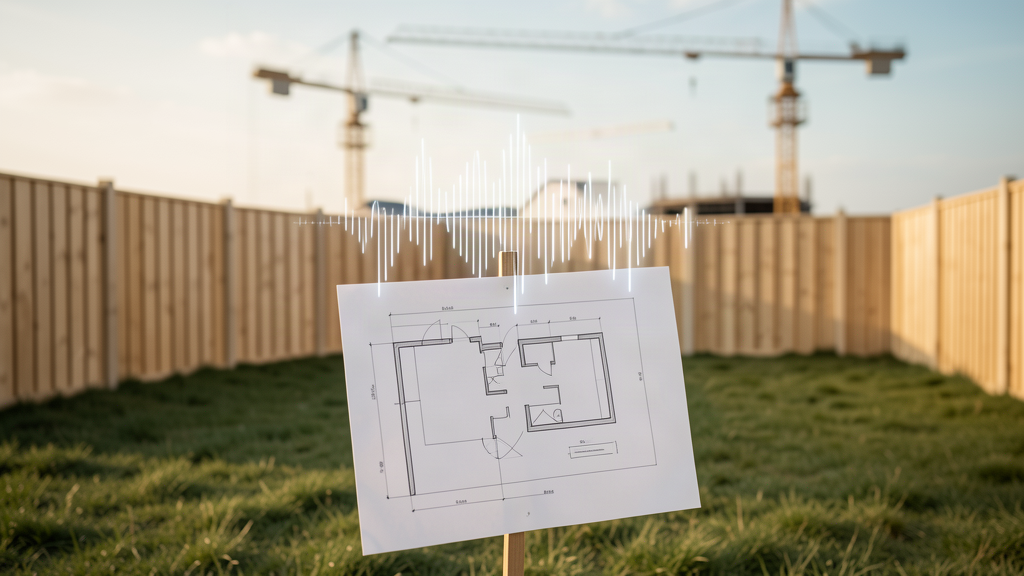
New-build and off-plan marketing has a fundamental problem that resale property marketing does not: you are asking someone to reserve a home that does not exist yet. There is no morning light to photograph. There is no kitchen to walk through. There is no garden to stand in. There is a planning document, a set of architect’s drawings, possibly a CGI render that looks nothing like any house that has ever been built, and a site address that Google Street View shows as a patch of scrubland or a demolished factory.
This is the market where a voice bite does more work than anywhere else — and it is the market most people selling AI voice tools have not specifically thought about.
What you actually have to work with
For a small-to-medium developer launching a scheme of 12 to 40 units, the typical marketing asset kit at launch looks something like this: a site name and branding, a CGI exterior render, a floor plan per unit type, a price list that you do not want to publish prominently, and a location description that says something like “nestled in the vibrant community of” followed by a town name.
That is what your sales agent is sending to Rightmove New Homes. That is what your website is showing to the prospective buyer who found you via a Google search for “new build 3 bed [town] 2025.” And that is why so many new-build launches underperform in the first 12 weeks — not because the product is wrong, but because the marketing cannot make the product feel real.
A CGI of the exterior tells the buyer what the front door might look like. It does not tell them anything about the street, the school catchment, the commute, the morning aspect of the south-facing plots, or why this particular development on this particular site was worth building here in the first place.
What a voice bite does for off-plan
A voice bite for a new-build plot can be built entirely from information that exists before a single brick is laid: the postcode, the development name, the unit type, the specification highlights, and the site location. Voceva uses the postcode to pull in real data about the surrounding area — school Ofsted ratings, walking distances to rail and bus connections, local amenities, and the character of the neighbourhood.
For a three-bedroom semi-detached on Plot 7 of a development in Quedgeley, Gloucestershire, the voice bite might sound like this:
“Plot 7 at Larkspur Mews — a three-bedroom semi-detached with south-facing rear garden and driveway parking for two vehicles. The development sits on the edge of Quedgeley, roughly three miles south of Gloucester city centre. The nearest primary school, Quedgeley Fieldcourt, is rated Good by Ofsted and is an eight-minute walk. Gloucester station is 12 minutes by car or 20 on the number 6 bus. Specification includes underfloor heating to the ground floor, A-rated appliances, and a 10-year NHBC warranty. Prices from £310,000. Reservations open now.”
That is 55 seconds. None of it required a photographer, a film crew, or a furnished show home. It gives the buyer things the CGI cannot: the commute, the school, the aspect, the concrete figures that help them decide whether to book an appointment at the sales cabin on a Saturday morning.
The school catchment argument
If you are marketing family homes, school catchment is often the deciding factor — sometimes ahead of price, sometimes ahead of specification. Parents researching a new-build will look up the catchment school themselves, but the family who hears “within catchment for Quedgeley Fieldcourt, rated Good by Ofsted” in the first 20 seconds of a voice bite has already processed a key concern before they reach the floor plan.
That sequencing matters in off-plan more than in resale, because buyers are making a much larger leap of faith. Anything that reduces the anxiety of that decision — concrete facts about the location delivered early — helps the conversion from interest to reservation.
A note on phase releases
Developments that release in phases — Phase 1 sells, Phase 2 goes live — can refresh voice bites for each release. The site location data stays the same. The plot-specific details change: different unit types, updated pricing, different aspects. Voceva regenerates the voice bite from the updated listing content. There is no need to commission new photography or create new marketing materials beyond updating the listing page text and price information.
For developers working with a sales agent who manages the digital presence on their behalf, Voceva installs on the agent’s WordPress site and the developer’s microsite simultaneously. The voice bite on the development’s own landing page and the voice bite on the agent’s listing page can be generated from the same content.
The cost comparison
A show home costs between £25,000 and £80,000 to fit out, depending on size and specification level. CGI renders run £1,500 to £4,000 per image. Drone footage of the site, if you have anything to photograph, is £300 to £800. These are necessary costs for larger schemes. For a developer launching 12 to 20 units, the economics of a full marketing suite are harder to justify.
Voice bites through Voceva cost a fraction of any of those line items and can go live on day one of the sales launch — before the show home is furnished, before the CGI renders are finalised, before there is anything to photograph. A floor plan, a postcode, a specification summary, and a price. That is enough to generate a voice bite that makes the listing feel real to a buyer who found it at 9pm on a Tuesday from their sofa in a town 40 miles away.
If you are a developer or a sales agent working on new-build and off-plan stock, voice bites are worth looking at before the CGIs, not after.